Selling online training involves much more than creating great content. Behind every registration, someone needs to process a payment, confirm the purchase, provide access, send reminders and answer questions.
When these tasks are spread across spreadsheets, email, payment tools and a separate training platform, even a simple purchase can create several manual steps.
For your customers, those gaps can mean waiting for access, juggling login details or contacting your team to figure out what happens next.
A learning management system (LMS) with integrated e-commerce can connect these steps, helping you simplify operations while making training easier to buy and access.
1. Keep your training catalog easy to manage
Your training offer will evolve. You may launch new courses, revise content, adjust prices or add dates for instructor-led sessions.
Managing those changes across several tools creates extra work—and more opportunities for inconsistencies. A price might be updated on your website but remain unchanged on a registration form. A course description might promise content that has since been revised.
A centralized catalog gives your team one place to manage course listings, descriptions, pricing and availability. You can add training or update existing offerings without rebuilding the registration process each time.
Customers benefit, too: they can browse a clear catalog and find the information they need before purchasing.
2. Connect purchases directly to training access
Consider a purchase that requires your team to check a payment, create an account, enroll the customer and email access instructions.
Each step takes time. It also makes the customer’s experience depend on someone being available to complete it.
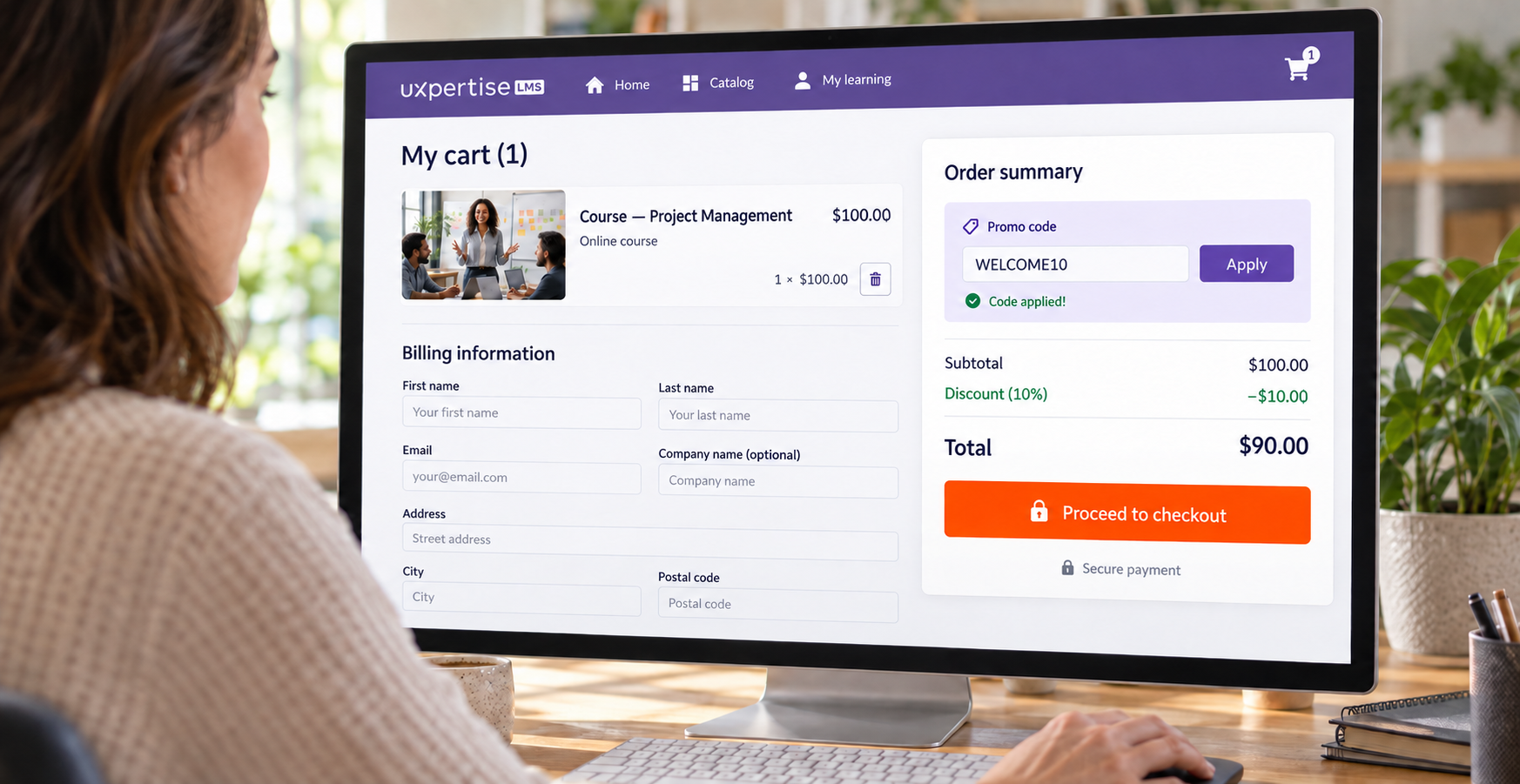
With an integrated shopping cart, customers can select their training and pay within the same environment. Once the purchase is completed, the LMS can automatically enroll them and provide access according to your settings.
For self-paced courses, that can mean starting right away. For scheduled training, it means receiving clear confirmation and the details needed to attend.
Your team spends less time processing registrations, and customers have a clear next step.
3. Automate confirmations and reminders
A successful payment should never leave a customer wondering, “What now?”
Purchase confirmations, enrollment details and reminders help people move through their training journey with confidence. Sending each message manually becomes harder as registrations grow.
An LMS can automate communications based on events such as a purchase, an upcoming session or an approaching completion deadline.
That helps customers receive relevant information at the right time while reducing repetitive follow-ups for your team.
The goal is to make routine communication reliable, leaving your team more time for questions that need personal attention.
4. Make promotions easier to run
A promotion should help generate sales without creating a new administrative process.
With integrated coupon tools, you can offer discounts for a campaign, a partner audience or returning customers. Buyers enter their code at checkout, and the discount is applied automatically.
That reduces the need to adjust payments manually or manage promotional registrations separately.
Depending on the platform, you can also set conditions such as expiry dates, eligible courses and usage limits to keep the offer manageable.
5. Give customers a clear, connected journey
Customers experience the whole process: discovering a course, purchasing it, finding their confirmation and accessing the training.
If those steps feel disconnected, your team may hear the same questions repeatedly:
- Did my registration go through?
- Where do I find my course?
- Which login should I use?
- When does my session start?
Bringing your catalog, checkout, communications and training access into one environment reduces those points of friction. Customers can spend more time learning, and your team can spend less time explaining how to get started.
Build a process that can grow with your sales
As your training business grows, every manual step multiplies. A process that works for ten registrations may become difficult to manage at a hundred.
Connecting sales and training delivery through an LMS helps you handle that growth with fewer repetitive tasks and a more consistent customer experience.
Want to simplify how you sell and deliver training? Discover how uxpertise LMS can help you manage your catalog, sell through an integrated shopping cart and automate key steps in the learner journey.