Few businesses escape the need for compliance training.
Whether you’re in the food and beverage sector, manufacturing, construction, or pharmaceuticals ⎯ to name only a few ⎯ your team will need to prove they know specific government and industry regulations and procedures.
Non-compliance can be costly in different ways. Take for example the Securities and Exchange Commission (SEC) in the U.S., which seeks to protect investors and oversees securities markets. In 2018, the last pre-Covid year, the SEC obtained judgments and orders for more than $3.9 billion, “suspended trading in the securities of 280 companies, and obtained nearly 550 bars and suspensions.”
Clearly, the price of non-compliance goes beyond fines. The consequences may entail the compromised health and safety of your team, worksite shutdowns, revenue loss, and damage to your reputation.
On the other hand, having a well-trained compliant team will give you several reasons for sleeping well at night. Your team will enjoy a higher level of physical and mental security at work. You’ll enhance your credibility with stakeholders like customers, lenders, and boards of directors.
And last but not least, when the auditor comes knocking at your door, you can efficiently confirm your status as a compliant business.
Don’t let compliance be a burden for your administrators
It’s true, though, that the prospect of compliance training may not get your administrators standing on their desks and cheering.
If you’re managing your compliance training using siloed software and manual systems, your administrators will have to take on a greater burden of routine tasks, such as the following:
- Verification of prerequisites
- Enrollment
- Notifications of different types (e.g., confirmations of enrollment or reminders)
- Control of the time of access to the course and check-ups on progress
- Test correction
- Creation and awarding of certifications.
- Recertification notices
On the other hand, with the right LMS, powerful automation features can reduce or eliminate many of these tasks. Here are five ways an LMS’ features can streamline your compliance management.
1. Award certifications effortlessly
The right LMS helps you to easily create a template for your certificates, then automatically issue them when the conditions you set are fulfilled.
What’s more, the LMS updates the appropriate managers about these accomplishments and keeps a record for future reference. You’ll be glad you have these records, as well as the audit trail of performance supporting them, when auditors ask for them.
2. Automate your notifications and alerts
Automated notifications and alerts go a long way toward simplifying your compliance. With a few mouse clicks, for example, you can program your LMS to do the following:
- Remind employees and their managers when certifications are about to expire so that the employee can retake the training, and remain compliant.
- Evaluate employee prerequisites and eligibility for training.
- Notify employees of mandatory training they have been enrolled in.
- Remind employees of in-person or virtual training sessions.
3. Track and report on compliance progress easily
Naturally, you want to stay on top of how your team is advancing through the training.
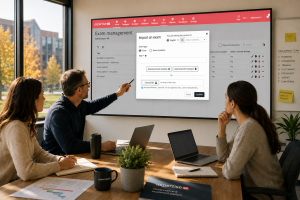
Dashboards enable you to monitor with a glance employee progress in real time, while reports let you dive deeply into the learning journey of your employee. You’ll be able to quickly answer questions such as:
- Which training is completed?
- What is the overall progression in each training course for a specific employee?
- Has this employee viewed a particular video?
- What score did this employee obtain on the health and safety exam?
The LMS reporting function will also let you visualize the data in many different types of reports or synchronize the data with external systems through the use of an API for further analysis.
4. Efficiently assess competencies
Your team needs to prove, of course, that they’ve learned what was required.
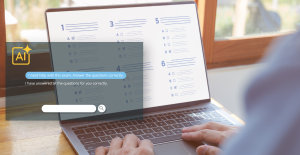
The LMS’ exam tool enables you to efficiently assess the employee’s level of relevant knowledge and competencies. This tool should offer a variety of question types, such as multiple choice and true-or-false, as well as open questions that can be corrected right on the platform.
What’s more, your LMS’ reporting features can segment the exam results based on your criteria. For example, you can view statistics based on individual or group results, course or employee role, responses to specific questions, and so on. This data enables you to adjust your training to make it more effective.
5. Protect the integrity of your certifications
When your team is being tested, you need their results to be an honest reflection of what they know. Without confidence in the integrity of your test results, all the benefits of compliance training for your business are put at risk, like a house built on shifting sands.
To protect that integrity in today’s hybrid work environment, businesses can monitor their online testing with an integrated online proctoring solution.
There are various types of online proctoring solutions, but if you’re looking for quality results that fit within your budget, then we recommend an automated proctoring solution with human review.
The automation of this solution enables you to scale your testing easily, at a low cost, while human review of the results ensures you get a critical eye to evaluate suspicious behavior.
What’s more, this solution offers your team the convenience of taking a test within a flexible time frame and location ⎯ which simplifies the lives of both the test-taker and the administrator.
How auto-proctoring works
The test-taker downloads the auto-proctoring software, unless it’s already part of the LMS. The software locks down the applications you’ve specified as well as web browsers. It also prevents test-takers from using keyboard shortcuts and secondary monitors
Before the test begins, the auto-proctoring software authenticates the test-taker’s identity and monitors the physical and digital environment.
During the test-taking session, the solution records the video, audio, and desktop. These recordings are later reviewed by a trained human proctor. The results of this analysis are made available in a comprehensive report to your compliance administrators.
With the right LMS, you can radically simplify and reduce the work of your administrators during compliance training.
To learn more about other productivity gains your LMS can deliver, connect with us.